

The island of Kyushu had been sitting pretty on my travel list for nearly a decade.
I had always planned to explore the entire region in one go, but once I actually started researching, I realized there was just way too much to see.
Between the scenic drives, historic towns, onsen villages, volcanic landscapes, and incredible food scenes, trying to squeeze everything into a one-week trip was going to be impossible.
So instead of spreading ourselves too thin, Papu and I focused our energy on Northern Kyushu—the half of the island that pulled me in the most. Our route took us from the modern city of Fukuoka, through the steaming hot springs of Oita Prefecture, and into the lush countryside and volcanic terrain of Kumamoto Prefecture.
Even though we hit some rain partway through the trip, we still had one of the most memorable and rewarding travel experiences we’ve ever had in Japan! The mix of greenery, quirky small towns, local specialty food, and classic Japanese hospitality made this road trip one for the books.
Honestly, we were really sad when this portion of our trip ended and we had to make our way to “the big city” (Osaka) for the World Expo 2025. We realized that even though we love Japan, we much prefer the slower pace of life in Kyushu!
Here’s everything we did on our 7-day road trip—we hope that by sharing what we did on our adventure, you’ll see why Northern Kyushu absolutely deserves a spot on your Japan itinerary.
This post may contain affiliate links. You won’t be paying a cent more, but in the event of a sale, the small affiliate commission I receive will help keep this blog running/pumping out useful and free content. Thanks a lot!
Table of Contents
An Overview Of Our Road Trip Route
- Route: Fukuoka → Beppu/Yufuin area → Aso-Kuju National Park area → back to Fukuoka
- Duration: 7 days
- Mode of Transport: Rental car (we rented with Toyota Rent-A-Car with an ETC card for tolls)
- Best Time to Go: Spring or fall for pleasant weather and colorful scenery
- When We Went: Mid-May
Days 1–3: Fukuoka


Fukuoka is Kyushu’s largest city, and because there is an international airport here, it became the natural starting point for our road trip. Prior to visiting the city for ourselves, all we knew about it was that it was home to some really good food.
That was not a lie. The food scene was next level!
Fukuoka is most famously known as the birthplace of tonkotsu ramen (or Hakata ramen, as it’s referred to locally), best enjoyed at a yatai (open-air food stall) along the river. If you’re a ramen fan, you’ll understand the weight of the following words: Ichiran and Ippudo are originally from Fukuoka!
You can easily fill your time here by exploring Ohori Park, Fukuoka Castle Ruins, and shopping at all the trendy shops in Tenjin or Canal City Hakata. It’s also a great jumping-off point for side trips to Dazaifu or Itoshima.


Local specialties to try: Hakata ramen, mentaiko (spicy cod roe), motsunabe (beef or pork offal hotpot), and mizutaki (chicken hotpot).
Days 4–5: Beppu, Yufuin, and Kurakawa Onsen


After we finished exploring Fukuoka, we rented a car from Toyota Rent-A-Car near the airport and set off to explore the rest of Northern Kyushu. The main attractions for the next two days? Onsen towns!
About two hours from Fukuoka sits the Oita Prefecture, the heart of hot spring culture in Japan and the area we were most excited to explore. Oita is the #1 prefecture in the country for natural hot spring output, and you can feel it as soon as you drive in.
Along the expressways, we saw sign after sign pointing to small onsen towns and ryokan areas tucked into the mountains or valleys—some we’d never even heard of. The ones we visited—Beppu, Yufuin, and later Kurokawa Onsen—barely scratch the surface of what this region has to offer.
Our first stop along the way was Nyoirin-ji Temple, also known as Frog Temple. It’s a quick 30-minute drive east from Fukuoka—and totally worth the stop.
The temple grounds are home to over 5,000 frog statues of all shapes and sizes, each one tied to wishes for safe travel and returning home safely. It’s just about the cutest temple we’ve ever laid eyes on!
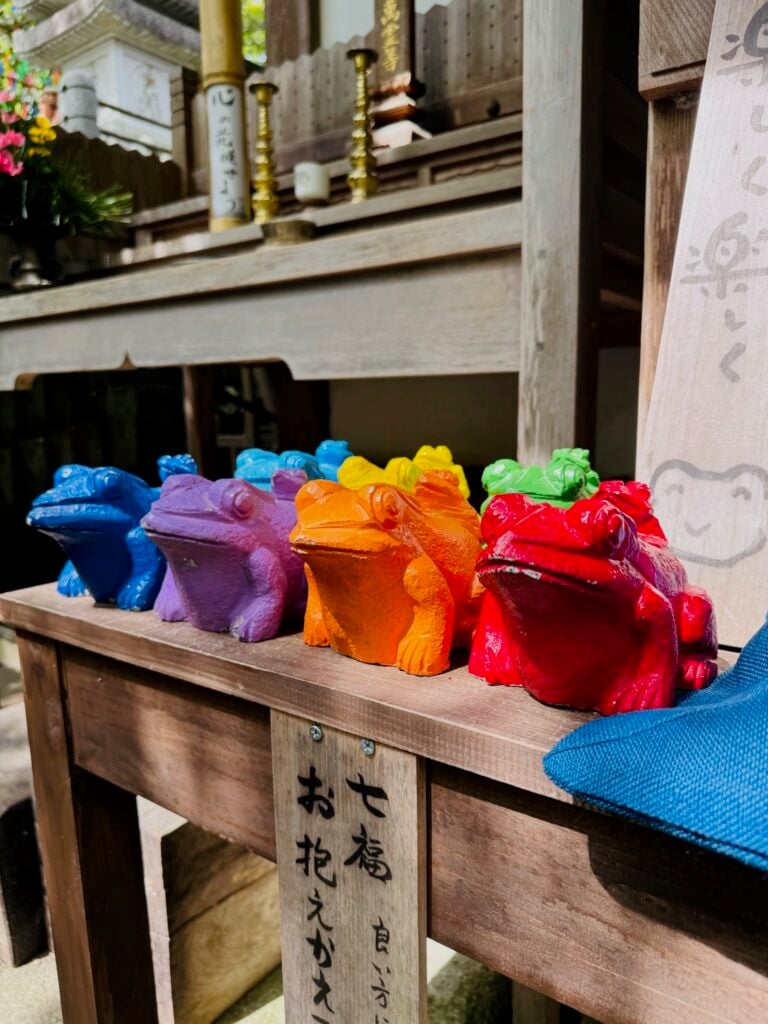


In the spring/summer, the temple becomes even more magical when thousands of colorful glass wind chimes are hung across the grounds. Every time the breeze blows, you hear a chorus of chimes echoing across the space—it’s whimsical, calming, and unlike anything else we saw on this trip!
You can also write your own wish on a wind chime for ¥500 and hang it up at the temple, or take home a frog-shaped omamori (amulet) for good luck.
Right next to the temple were a couple of bakeries and cafes, perfect for picking up coffee and treats for the rest of our drive over to Beppu. We really enjoyed the breads and pastries from pain nest.


Already, we were starting to see how lush and green Kyushu was, which got us super excited for the rest of the trip!
From there, we continued on toward Oita Prefecture—our base for the next couple of days. We spent our first day in the Oita area (Day 4) exploring Beppu and our second day (Day 5) exploring Yufuin.
For the uninitiated, Beppu and Yufuin are two of the most famous onsen towns in Kyushu. We wanted to visit both because while they are pretty close to each other, they could not be more different in atmosphere.
First up was Beppu. It’s both steamy and gritty, famous for its “hells” (jigoku)–colorful hot spring displays you look at rather than bathe in. It’s similar to the ones you see at Yellowstone National Park.

Despite being famous for its hot springs, it’s actually more of a city. It was way bigger than we had expected it to be and likely not what you’d picture when you think “onsen town”.
Still, we had a lovely time basing ourselves there for two nights as we explored the city and the rest of the Oita area.
Since we’d already seen geothermal wonders in places like Yellowstone, we didn’t feel the need to hit all seven hells. Instead, we chose just two of the most impressive ones—Umi Jigoku (Sea Hell) and Chinoike Jigoku. That gave us enough time to explore the rest of Beppu on foot without rushing.


After the hells, we made our way to a steam cooking workshop restaurant for jigoku-mushi—food cooked with natural hot spring steam. It was simple, yet incredibly delicious!
Later in the afternoon, we wandered through the Kannawa district, where the streets themselves feel like a spa—steam rises from the ground all around you, and little foot baths and old bathhouses pop up around every corner.


Yufuin, by contrast, is smaller, slower-paced and more of a traditional-feeling onsen town. It feels village-like, with picturesque streets full of fun souvenir shops, matcha cafes, sweet shops, and homey restaurants.
The next morning, we left our hotel in Beppu and drove 30ish minutes on some winding mountain roads to get to Yufuin. The drive over was super pretty!


Everything about Yufuin was so my vibe, from the old town feel of Yunotsubo Kaido to the random English Cotswolds-themed village that makes up Yufuin Floral Village!
As we were strolling and snacking our way through town, it was so hard to ignore the epic views of Mount Yufu in the near distance.
We spent about 6 full hours exploring all the nooks and crannies Yufuin had to offer. We had the most incredible lunch at Yufumabushi Shin, featuring the protein Yufuin’s most famous for: Bungo beef!
We even took time out of our day to soak in a private onsen (that we rented for the day at a local ryokan).


If funky and kitschy attractions are what you’re after on road trips, Yufuin’s got some surprisingly quirky attractions in store for you (like the Yufuin Floral Village, Snoopy Village, Yufuin Showa Museum, and the Retro Motor Museum)!
On the day we checked out of our hotel in Beppu, our plan was to drive to Mount Aso area to spend the following two days, but not before a quick pit stop: Kurokawa Onsen.
Located in the forested hills of Kumamoto Prefecture, this onsen village is quieter, more rustic, and designed for soaking and relaxing amidst nature.
While tiny, it’s easily one of the most picturesque onsen villages we saw in Kyushu—think wooden bridges, stone paths, and high-end ryokan shrouded by Japanese maple trees.

Many of the traditional ryokan here have beautiful outdoor baths surrounded by greenery, and you can hop between them using a bath-hopping pass.
We had originally planned to try out a few of the public bathhouses, but since we were already booked into a hotel with its own hot spring baths that night, we decided to skip the extra soak and spend time enjoying a VERY delicious lunch at Tsuji no Chaya, a small roadside teahouse owned by an elderly couple.
After lunch, we stopped at the town’s information center to learn more about the bathhouses (in the slight chance we did want to soak in the onsen), mainly because Papu has a half-sleeve and we wanted to make sure we weren’t wasting time trying to enter a place that wouldn’t allow tattoos.
They were super helpful and gave us a list of which ryokans were tattoo-friendly—definitely worth a stop if you’re in the same boat.
We spent the rest of our short visit popping into sweets shops, trying more onsen-boiled eggs, and just wandering the quiet streets while admiring all the traditional architecture.
Even without bathing, Kurokawa was such a cute detour—a peaceful, scenic pocket of Kyushu that’s perfect for a slow mid-morning stroll.


💡 Fun Fact: Kurokawa Onsen has earned many accolades, including a two-star rating in the Michelin Guide to Japan and the top spot in the “Atmosphere” category of Japan’s best hot springs!
Local specialties to try: Bungo beef (especially in Yufuin), jigoku mushi (onsen-steamed foods), and dango-jiru (dumpling soup).
Days 6–7: Mount Aso
From Kurokawa Onsen, we headed south towards Aso, home to one of the world’s largest active calderas.
The landscape here was a complete 180 from what we’d seen so far—wide open grasslands, crater lakes, grazing cows, and panoramic mountain views. It was so foggy during our time here, but that didn’t stop us from snapping some really pretty photos of the area.

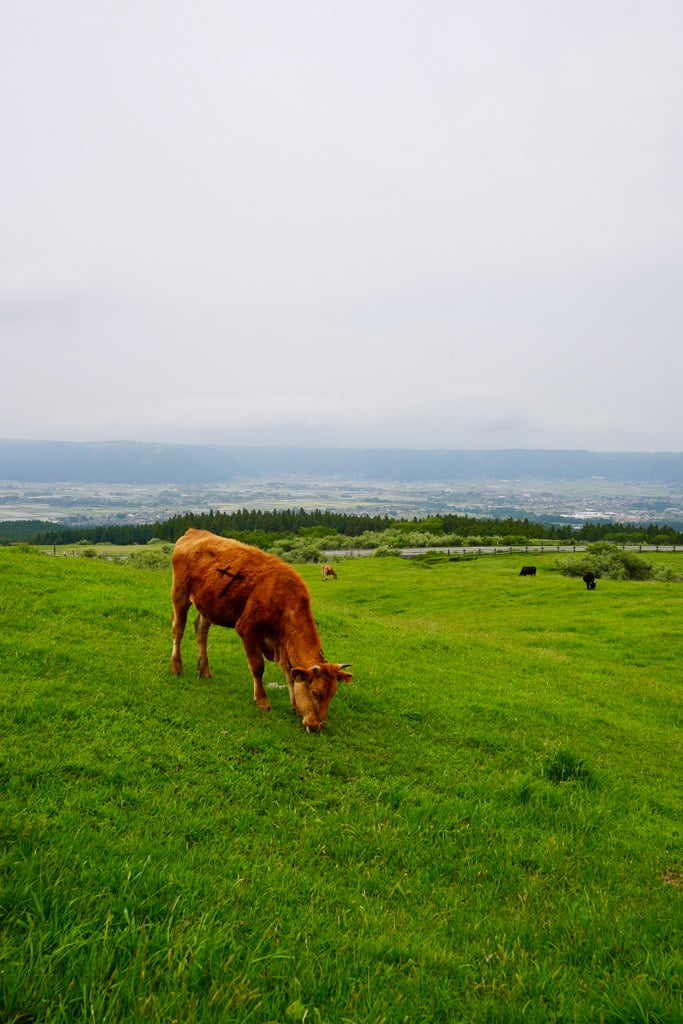
After our morning stroll through Kurokawa Onsen, we originally had Daikanbō Lookout on the itinerary, but Mother Nature had other plans. The fog was so thick that we couldn’t see more than 20 feet in front of us—everything was completely white.
So we made the call to skip it and headed straight to our hotel: Kamenoi Hotel Aso.
We freakin’ LOVED this hotel. Aside from having 5+ communal onsen baths per gender, the property itself was a playground—literally! They have a massive open field that looks like a golf course, but it’s actually just for hotel guests to relax, play sports, and run around on.
And then there was dinner. The buffet honestly blew us away. We went in with low expectations (as you do with buffets in the USA), but everything was incredibly fresh—YES… even the sushi.
The next day, we set off to explore the area properly. We started with Kusasenri Grassland, a huge open plateau at the base of Mount Eboshi.
In the US, we’re used to paved paths that keep us off the grass, but this was one of those “walk wherever you want” on top of the grass kind of places—no real trails, just soft grassy hills you can climb for panoramic views of the surrounding peaks.

From there, we drove over to Aso Nakadake Crater 1. After parking, we spent time exploring around the edge of the crater (depending on volcanic activity levels, of course). The first thing we noticed was the eggy, sulfuric smell.
It sure was active, with plumes of steam rising from the center—a cool contrast to the soft green grasslands we had just come from!


After heading back to the main visitors center to eat lunch and enjoy a mid-day coffee, we headed out to our next and final stop: Sensuikyo Gorge.
This spot was a non-negotiable for me — I had to see it with my own eyes! In the spring, nearly the entire gorge is dotted with bright pink azaleas in bloom. Outside of that season, it’s probably a bit skippable—but in April/May, it’s drop-dead gorgeous.
After walking up the hills of the gorge, we drove back to our hotel to onsen soak, eat dinner, and relax for the rest of the night. This was the end of our near-perfect week in Northern Kyushu.
Local specialties to try: Aso milk and soft cream, Akaushi (red beef), basashi (horse sashimi), and dengaku (miso-glazed grilled vegetables and tofu).
Return to Fukuoka
After our breakfast buffet, we wrapped up our trip with a scenic drive back to Fukuoka to return our rental car.
For fun, we made a quick pitstop at a Costco to get gas and check out their food court/ merch offerings. It was so much better than the USA Costco!
From there, we headed straight for the airport for some last-minute souvenir shopping. I ended up buying lots of Hakata ramen and mentaiko rice crackers for my friend/family back home.
It was our final chance to enjoy mentaiko this fresh, so we treated ourselves to a beef and mentaiko bento box before flying out to Osaka for the rest of the trip.
Where To Base Yourself: Beppu or Yufuin?

If budget were no concern, I’d absolutely choose to stay in Yufuin over Beppu.
Beppu has a city-like feel, whereas Yufuin is more compact, more pedestrian-friendly, more scenic, and has that cozy onsen village charm that makes it feel like a proper escape.
That said, Yufuin accommodations tend to book up quickly and are generally more expensive since many of the accommodations are ryokan (traditional inns).
Since we planned our trip a bit last-minute, most of the Yufuin stays were already full, which is how we ended up basing ourselves in Beppu. And honestly? It worked out fine because we had a rental car with us.
Beppu is much larger, has a ton of food and onsen options, and is a great home base for exploring both towns. It’s also better connected for day trips. With that said, it just lacks that quintessential onsen village feeling.
If you’re someone who values convenience and doesn’t necessarily need to stay in a ryokan, Beppu is the more practical choice. However, if you’re after a slower, more picturesque setting and are willing to splurge, go with Yufuin.
Driving in Japan: What to Expect
This was our first time driving in Japan, and yes—it was also our first time driving on the left side of the road. We were nervous at first, but honestly, it was more manageable than we expected!
The hardest part? Leaving the car rental lot in the city for the first time. You’re nervous and just getting the feel of a Japanese car where some features are opposite (like the windshield wipers and the turn signals).
The IC (interchanges, or highways) can also be pretty confusing. Google Maps is a bit delayed at telling you which lane you need to be in, so it’s best to have the passenger read the physical road signs and tell you which exit to take / which lane to get into.
The easiest part? Driving in the smaller towns and in the countryside! It’s mostly open country roads with low traffic, clear signage, and well-paved roads.
We rented a car through Toyota Rent-A-Car, but other popular local options include Nippon Rent A Car and Nissan Rent A Car. When we were in Japan, we saw these three brands at nearly all the major airports.
When you rent the car, choose the option that includes ETC. ETC is the automated toll system that lets you drive right past toll gates in the ETC lanes. Once you go to return your car, you’ll pay all your toll fees you’ve accumulated on your trip.
You can compare prices between the major brands using Klook’s car rental search.
Important: You must have an International Driving Permit (IDP) to rent and drive a car in Japan. Get it before your trip—Japan doesn’t issue them locally. If you don’t have one, they won’t rent to you. We are based in the USA and got ours at our local AAA.
Planning Your Trip To Japan?
Here are a few other useful travel guides to help you plan the perfect trip to Japan.
Kyushu Region
- 10 Reasons Kyushu Is Japan’s Best-Kept Secret: Volcanoes, Onsen, and More!
- How To Spend A Perfect Day At Yufuin Onsen, Japan
- 15 Unmissable Things To Do In Beppu For First-Timers
- 7 Best Ryokans In Beppu, Japan (With Private Onsen)
- 10 Amazing Onsen Towns In Japan To Visit On Your Next Trip
