

My first trip to Taiwan with the family was unforgettable, to say the least. It was even more special because I had my mom as my personal tour guide.
Growing up in Hong Kong, she had visited Taiwan countless times, often just for weekend food getaways, and she knew all the local spots you wouldn’t find in guidebooks.
Even though I grew up eating Chinese food, I was genuinely blown away by how much more there was to Taiwanese cuisine when I was actually in Taiwan. There are so many more flavors, techniques, and ingredients that are harder to find in restaurants back in the U.S.
Taipei itself is a feast for the senses. From the chaotic energy of the night markets with their sizzling street eats and boba tea stands, to serene temples tucked between modern skyscrapers, every corner of the city offers something to see, smell, and taste.
Cafés, beef noodle soup shops, and hidden eateries constantly pull you in, while creative neighborhoods and nearby mountain trails provide a welcome break from the urban hustle.
This 3-day travel guide is a done-for-you itinerary for Taipei, perfect for first-time visitors who want to experience the best of Taipei without feeling overwhelmed.
In just three days, you’ll hit the city’s top sights, sample its unmissable foods, and get a real sense of the city’s culture—all while having plenty of opportunities to wander and explore on your own.
This post may contain affiliate links. You won’t be paying a cent more, but in the event of a sale, the small affiliate commission I receive will help keep this blog running/pumping out useful and free content. Thanks a lot!
Table of Contents
DAY 1: A Taste Of Taiwanese Culture
Pick up your transportation passes


While in Taipei, you’re going to want some form of cashless transportation card.
Having to deal with a single card that you can tap on the pay machine as opposed to fumbling with messy bills and coins is a game-changer, especially in a city where the general population relies so heavily on public transportation.
While entering the subway station/bus, there WILL be a line of other people behind you, so you’re going to want to tap and go quickly.
You have two choices here: the EasyCard or the Taipei Fun Pass. Both are available for pickup at the airport.
- The EasyCard: These are super convenient IC cards that let you take multiple forms of public transportation (pay-as-you-go) and pay for items at convenience stores and markets.
- The Taipei Fun Pass: These passes are for short-term visitors who plan to use public transportation frequently and/or plan to visit many tourist attractions. There are 4 different kinds of fun passes to choose from; some come with admission to Taipei’s main paid attractions, and some just come with unlimited transportation.
Get from TPE Airport to Taipei
Despite the TPE Airport sounding like it’s within Taipei, the TPE Airport is actually called Taoyuan International Airport, located in the neighboring city of Taoyuan about 30 minutes away from Taipei.
You’ll have to account for about 35 minutes to 1.5 hours of transportation time to get from the airport to Taipei proper.
Depending on what time you fly into Taipei, you’ll take the bus (4-digit bus), train (Taoyuan Airport Express), or pre-arranged private transfer.
STILL NEED AN E-SIM FOR YOUR TRIP? Our go-to eSIM provider is Airalo! For a limited-time, you can use promo code AIRALOESIM10 for 10% off your booking. Explore all their affordable plans here.
I typically don’t mind taking the bus/train when I’m traveling lightly with my partner, but as I was traveling with my parents who are older, we opted for a comfortable, door-to-door private transfer. This is my favorite way to get around when traveling with parents, younger kids, or with lots of bulky luggage.
We booked our private transfer through Klook, and while it was my first time using Klook ever, it was a totally simple and seamless experience!
You’ll provide the transportation company with your flight info so they know what time to show up, and from there, you have a complimentary 1.5 hours of time to show up (to account for customs, baggage claims, and any flight delays).
You can compare prices and book through Klook here.
Check In To Your Hotel
From there, you’ll either check in to your hotel or, at the very least, drop off your luggage at your hotel.
As Taiwan was just opening back up for tourism, I was able to snag a few nights at the Regent Taipei for a really affordable price. Their seemingly endless breakfast buffet was the best addition to my time in Taipei and I would 100% stay at this hotel again!


Here are some of my other favorite hotels in Taipei to call home base:
- Regent Taipei – A pretty centrally located hotel so you can get to various landmarks without long rides on public transportation. Don’t miss their award-winning beef noodle soup, or their amazing breakfast and dinner buffets!
- Kimpton Da An Taipei – My #2 hotel choice, super conveniently located right by the MRT Blue Line.
- Grand View Resort Beitou – luxurious hot springs hotel with private hot springs! Just 1-2 nights here will do, as it’s on the pricier side.
- The Grand Hotel – love the iconic palace-inspired exterior.
Yongkang Beef Noodles

First and foremost, get a proper Taiwanese meal in your belly. I mean, you came to Taiwan to eat, right?
One of the most iconic Taiwanese foods is beef noodle soup. You’ll find beef noodle soup in all corners of Taipei, but not all of them do it well.
The #1 beef noodle soup I had in Taipei was at Yongkang Beef Noodles.
Everything about this beef noodle soup was amazing. From the tender meat to the QQ (chewy) noodle texture to the rich soup — it was pure perfection! Expect a very casual environment and a long line if you’re visiting during peak dining hours.
Pro Tip: The lunch rush is real in Taipei! For shorter lines, visit around 1:30 pm to 4 pm. We visited around 1:30 pm and only had to wait 5 minutes.
Post-Lunch Bites
From there, stroll on over to Soypresso to try a soymilk-flavored soft serve, or simply opt for a bottle of soymilk.
There is also a super popular scallion pancake stand in the area, Tian Jin Onion Pancake, so if you have space in your tummy, definitely order a few slabs to try. The scallion pancakes here are crispy, fragrant, and delicious!


Lastly, if you’re thirsty for nutrients and antioxidants and happen to pass by a fruit market, pick yourself up a bottle of freshly squeezed fruit juice!
National Chiang Kai-shek Memorial Hall

Kick off your 3 days in Taipei with a dose of history at the National Chiang Kai-shek Memorial Hall.
The grounds are impressive enough to warrant a quick walkthrough: huge open plazas, bold white-and-blue architecture, and a towering statue of Chiang Kai-shek inside the main hall.
If you’re looking for deeper context on Taiwan’s complex past, save your energy and your questions for Day 2, which is the perfect time to join a guided tour led by a local who can actually break things down in a way that makes sense.
If you do stop by, plan on no more than 20–30 minutes unless you’re exploring the exhibition rooms or sticking around for the hourly guard change.
Nanmen Market
Just a few minutes away, Nanmen Market is a great intro to everyday Taiwanese life.
You’ll find stalls packed with noodles, dried goods, sauces, and classic deli-style counters selling ready-to-eat dishes. You can wander aimlessly around for half an hour and quickly understand how locals shop and eat.
Expect everything from steamy braised pork lunches to shelves of traditional snacks your Taiwanese friends grew up with.
Huashan 1914 Creative Park

Huashan 1914 Creative Park is one of Taipei’s best examples of how the city gives old industrial spaces a second life. What you’re walking into used to be a sake distillery from the early 1900s.
Instead of tearing it down, Taipei transformed the warehouses into a creative hub—part art space, part shopping zone, part hangout spot.
If you’ve never been to a “creative park,” think of it as a community space built inside old factory buildings, filled with indie shops, rotating exhibitions, cafes, design studios, and spots where local artists show off their work.
You can browse galleries, shop for handmade goods, grab coffee, or catch a film at the onsite theater.


If you’re traveling with kids, there’s plenty to keep them engaged too—an outdoor playground, a rock climbing wall, and the super cute Wooderful Life Wooden Forest with hands-on wooden play zones.
There’s also a small museum explaining the site’s past life as a sake factory, which adds helpful context to what you’re walking through.
Pro Tip: Weekends often come with pop-up markets or seasonal events. When I visited, there was a holiday market right at the entrance with local vendors, crafts, snacks, the whole deal!
Guanghua Digital Plaza and Syntrend

At this point, we’ve gotten a little dose of history, a little dose of arts and creativity — next up is a dose of digital goodness!
The next stop is a visit to the Guanghua Digital Plaza and the Syntrend shopping mall, located just a 6-10 minute walk from Huashan 1914 Creative Park.
These two massive buildings feature electronics stores ranging from tiny hardware shops to huge international brands.
The Syntrend Electronics Building is an expansive complex that offers up the latest gadgets, gizmos, and technology. Walk through the doors and you’ll be greeted with a wide range of stores featuring the latest and greatest in tech.
In addition to electronics, there’s also an array of underground cafes and restaurants offering you the chance to refuel and rest.
In total, there are a whopping thirteen floors to this building! With its stylish architecture and bustling atmosphere, it’s easy to lose track of time as you explore all that Syntrend has to offer.
My dad is a huge fan of electronics. Me? Not so much. But still, I found this area pretty interesting to explore! Speckled between the electronic shops are gift shops selling everything from lifestyle bags, minimalist design gifts, stuff for coffee lovers, and unique souvenirs.


If you still have the energy to visit the Guanghua Digital Plaza, head there next. Not only can you get all your tech needs taken care of, but you can also find plenty of creative souvenirs and trendy clothing stores too.
Trust me, you’ll have a good time exploring this area! Take your time wandering around the five floors and soak up the atmosphere – it’s easy to spend hours here browsing through endless gadgets and gizmos.
Visit a night market

If you want to understand Taipei at its core, you need to spend at least two nights wandering its night markets.
This isn’t just a thing to check off your itinerary. Night markets are part of daily life in Taiwan! Families come for dinner, students grab late-night snacks, and vendors specialize in recipes they’ve perfected over decades.
The most well-known of all is Shilin Night Market. It’s the one you’ve probably seen in YouTube videos and TikToks, so expect huge crowds, giant fried chicken steaks, blow-torched seafood, the works.
Night markets usually kick off around 4–5 pm and run until well past midnight, so you can fit them into your schedule no matter how your day plays out.


If you need a little guidance on Taiwanese street eats, I’d highly recommend going on a guided food tour.
Doing one early in your trip will pay off fast! You’ll learn what dishes at the night markets are worth the stomach space, how to spot the good vendors, and what’s actually considered a “must” by locals.
By the time you hit your next night market, you’ll know exactly what to look for instead of wandering, guessing, and ordering something you won’t enjoy.
👉 Recommended Tour: Taipei Food Tour by Secret Food Tours
DAY 2: Explore Iconic Landmarks In Taipei

Kick off Day 2 with a Taipei Highlights Tour, which is hands-down the easiest way to cover a ton of cultural ground without worrying about navigating on your own.
Your guide handles all the transportation, directions, and timing, so instead of staring at Google Maps all day, you can actually look up and take in the city.
You’ll spend the morning diving into Taiwan’s deep cultural roots at the National Palace Museum, home to one of the largest collections of Chinese artifacts in the world. From there, you’ll walk through Dadaocheng and Dihua Street, two historic neighborhoods where old tea shops sit next to design boutiques, temples, and café-lined alleys.
👉 National Palace Museum Highlights: Among over 700,000 items in its collection, some of the most popular exhibits include the jade collection, calligraphy gallery, painting gallery, and–of course–the pork belly and jade cabbage!
Midday, you’ll be dropped off in Ximending for lunch, were you’ll find everything from Michelin-rated noodle shops to snack stalls and quirky local shops all within a few blocks.
Afterward, the tour moves on to Lungshan Temple to give you a closer look at Taiwan’s religious practices, followed by a stop at Chiang Kai-shek Memorial Hall to see the changing of the guard.
The last stop is Taipei 101 Mall, where you can explore on your own or ride up to the observatory for skyline views (optional).
By around 5pm, you’re wrapped up and free again! Hopefully, with plenty of energy left for deeper exploration of Taipei 101 and some night-market grazing.
Taipei 101

Located in the heart of Taiwan’s bustling capital, the Taipei 101 skyscraper is one of the most iconic buildings in Asia. With its magnificent height and amazing architecture, it is sure to take your breath away.
Spend some of your time in Taipei exploring every inch of this majestic building! From the iconic observatory deck at the top to the expansive shopping mall below, there are plenty of amazing experiences to be had.
The building houses some of the best shopping in Taipei, with high-end stores selling everything from clothes to jewelry to electronics.
Food lovers will appreciate the fact that there is a Din Tai Fung here, known for its perfectly wrapped xiao long bao, in addition to a bunch of other food vendors in the downstairs food court.


Other notable food options include Hawker Chan (the first Hawker to be awarded a Michelin star), warm taro ball desserts, and even hot pot!
Pro Tip: Entry to the Taipei Observatory is included on the Taipei Unlimited Fun Pass!
Elephant Mountain Sunset Hike

If you still have some gas left in the tank, this is the moment to squeeze in the quick climb up Elephant Mountain.
I personally didn’t get to do it on this trip because I was traveling with my elderly parents and didn’t want to push them up several flights of stairs after a full day of sightseeing (but you already know it’s already bookmarked for a future visit with Papu).
The trail is short (about 0.9 miles / 1.5 km round-trip) and straightforward, with plenty of rest stops. Most people make it to the top in about 20–30 minutes.
The payoff is a quintessential view of the city: Taipei 101 towering over the rest of the glowing city!
The trail starts near Xiangshan Station (Exit 2), and it’s about a 10-minute walk to the trailhead. It’s mostly steps, so pace yourself, bring water, and expect to get a mild leg workout.
Raohe Night Market

Once you’ve wrapped up your evening plans, Raohe Night Market is a great place to end the day.
When I visited, it was pouring rain, so only a handful of vendors were actually open. The upside? No crowds. The downside? I kept thinking about how electric this place must feel on a normal night when every stall is running and the walkway is packed shoulder-to-shoulder with people holding squid skewers, tea drinks, and bags of fried snacks.
f the weather cooperates on your visit, expect a fuller lineup of stalls with everything from black pepper buns to flame-torched beef, plus a good mix of clothing and accessories at budget prices.
Raohe typically runs from around 5 pm to 11 pm. On a dry night, this place can easily become the highlight of the whole day!
DAY 3 – Jiufen and Ximending District
Day trip time! Depending on whether you want to start your day trip off with a physical hike, Jiufen can be explored in about 3 to 6 hours and can be done as a half-day trip.
For the second half of the day, you’ll head back to Taipei to explore one of Taipei’s liveliest districts.
Day trip to Jiufen

No trip to Taipei is complete without a visit to the historic streets of Juifen.
Located in the New Taipei City district, just 40 minutes outside of downtown Taipei, this traditional Taiwanese hillside village offers tourists an unforgettable glimpse into the past.
Jiufen is renowned for its cobblestone streets lined with colorful shops and eateries that serve up some of Taiwan’s most beloved dishes. Wander through the alleyways of Jiufen Old Street where you can find snacks such as sweet taro balls and peanut ice cream made from locally grown ingredients.
Stop by souvenir stores for beautiful handmade pottery or buy a few trinkets to remember your experience in this charming town!
If you want to experience what a traditional tea house feels like, head to A-MEI Tea House. Albeit a bit pricey (likely due to the tourism here), it can be worth it for travelers who aren’t familiar with traditional tea-drinking ceremonies.
Other notable places to dine include A-Jou Peanut Ice Cream Roll, 賴阿婆芋圓 (Lai Ah Po Taro Balls), and Siidcha (tea house with yummy foods and a great view).
If you’re an avid hiker looking to explore the hillsides of Jiufen, one of the most popular hikes here is the 2.2-mile out-and-back Teapot Mountain Trail. This is a great hike to do either before or after exploring Jiufen Old Street!
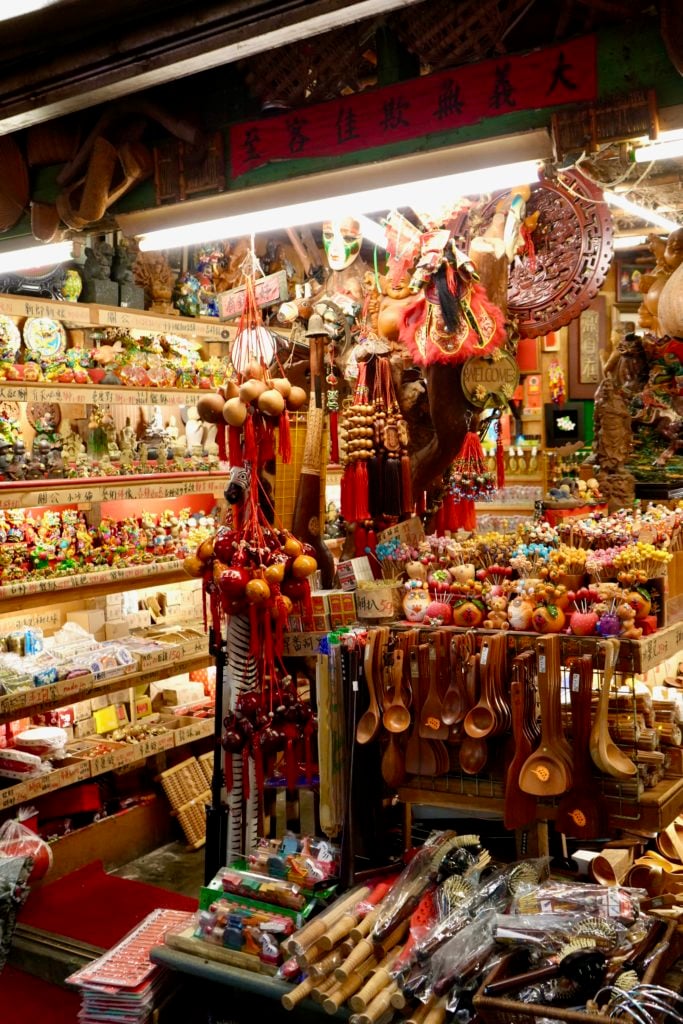
Pro Tip: If you’re looking for gifts to bring home, Jiufen is a great place to find traditional Taiwanese souvenirs, as I found these items to be few and far between in Taipei.
Don’t want to deal with the logistics of getting to Jiufen via public transportation? The most convenient way to see Jiufen (plus a few other awesome attractions) is via a guided tour. This is the one I recommend the most:
Honestly, if you wanna see Jiufen and Shifen both in one day, the easiest way is with a half-day guided tour. Doing it on your own via public transportation, while doable, is a big pain in the butt (with lots of bus/train transfers) because the two towns are not very well connected.
This tour also includes bonus stops to Golden Waterfall and Yin-Yang Sea, a natural wonder where yellowish mineral-laden water from the mountains mixes with deep blue seawater, creating a striking two-tone contrast.
Bopiliao Historical Block
Bopiliao is one of those places in Taipei where it is immediately apparent that Taipei has layers.
The area dates back to the 1600s, and because Taiwan passed through several ruling eras, you see that history right in the buildings: Southern Fujian-style brickwork next to Japanese-era shop houses, followed by more modern touches.
On my visit, what stood out most was how quiet and easy it was to wander compared to the rest of the city. You’ll see restored storefronts, educational exhibits, and old alleyways that look exactly like the photos from decades ago.
It’s compact, so you don’t need more than an hour unless you’re someone who likes to read every plaque.
If you’re into history, make sure you duck into the Heritage and Culture Education Center on the southeast side near Laosong Elementary School. It’s a small museum with two floors of free exhibitions that give helpful context about Taipei’s early communities and daily life.
Lungshan Temple

Just a 5-minute walk from the Bopiliao Historical Block is the Lungshan Temple. If you did the Taipei city highlights tour, you’ll have come here already. If not, make some time in your itinerary to check it out.
This ornate temple has been around since 1738 and is a symbol of faith, culture and history. The intricate exterior is a sight you need to see for yourself! From the elaborate carvings on the walls to the sculptures of gods, goddesses and dragons adorning every corner, you won’t want to miss out on seeing this with your own eyes.
Plus, it’s free admission and conveniently located in the Wanhua District, close to Ximending! The temple is open from 6 am to 10 pm.
The Red House

Located near Ximending Shopping District, this historical landmark is home to a vibrant art space and performance venue.
The Red House was originally built in 1908 as Taiwan’s first public market. Today, it stands as an important reminder of the country’s past and present culture. Visitors can explore the space’s eight galleries featuring art installations, live performances, films, and cultural activities.
With its lively atmosphere and unique attractions and gifts for sale, The Red House will provide an unforgettable experience that will make you want to come back trip after trip.
Shopping and Eating in Ximending

There’s no better place to explore than Ximending, my favorite district in all of Taipei for shopping and eating!
This electrifying area is the epicenter of fashion, culture, and nightlife in Taiwan’s capital city. In fact, it’s often dubbed the “Shinjuku of Taipei”. Just like the Shinjuku district in Japan, you’ll find lots of Taipei’s youth hanging out in this area!
Take a stroll down Wuchang Street and soak up the atmosphere as you browse the eclectic range of shops selling everything from traditional handicrafts to trendy hats and fashionable clothing.
Don’t forget to sample some street food too – there are dishes for all tastes, whether it’s a steaming bowl of beef noodle soup, grilled mochi, or a sweet mango smoothie.
If you are interested in nightlife, you can make it a point to stick around until night falls to experience Taipei’s lively nightlife.
Other Things To Do In Taipei
If there are some activities in our 3-day Taipei itinerary that you’re just not that interested in, feel free to swap them out for a few of these other Taipei activities listed below:
- Visit Thermal Valley in Beitou
- Have an overnight stay in a hot springs hotel
- Ride the Maokong Gondola
- Jianguo Jade Market (open on weekends)
- Songshan Cultural and Creative Park
- Fuhe Bridge Flea Market
- Explore Dihua Street in Datong District
- Visit Taipei Zoo
- Take a day trip to Yehliu Geo Park
- Miramar Entertainment Park Ferris Wheel
- Taipei Children’s Amusement Park
- Zhonghe Myanmar Street
- Take a hike in Yangmingshan National Park


Where To Eat In Taipei
Here are a few restaurants that I visited and vetted are A+ delicious! Add these to your list and make them a priority if you happen to be near them during your trip.
- Jin Feng Braised Pork Rice – Zhongzheng District
- Fuhang Soy Milk – Zhongzheng District
- Simple Kaffa (coffee shop) – Zhongzheng District
- Yongkang Beef Noodles – Da’an District
- Tian Jin Onion Pancake – Da’an District
- Snow Bro – Da’an District
- Yong He Soy Milk King – Da’an District
- Sihai Soy Milk – Datong District
- Ay-Chung Flour-Rice Noodle – Ximending District
- 道樂商店 (Ramen) – Ximending District
- Addiction Aquatic Development – Zhongshan District
- Ching Cheng Hainan Chicken Rice – Songshan District
- Hai Di Lao Hot Pot – Songshan District
- Ding Wang Hotpot – Songshan District
Where To Stay In Taipei
The two neighborhoods I recommend staying in are:
- Ximending – if you want to be in a bustling district close to shopping and dining
- Zhongzheng – centrally located right by Taipei Main Station, so you’re never too far away from any landmark
These two districts are actually located right next to each other, so either area will do just fine!
Ximending Hotels
Just Sleep – Ximending – newly renovated in 2019; just a short 2-minute walk from MRT Ximen Station and Ximending Shopping Area.
Hotel Midtown Richardson – simple and sleek rooms located right next to MRT Ximen Station.
Zhongzheng Hotels
Via Hotel Taipei Station – sleek and minimalist hotel close to Taipei Main Station, National Taiwan Museum, and Ximending Shopping Area.
Hotel Resonance Taipei, Tapestry Collection by Hilton – conveniently located, modern hotel with king-sized beds, great for couples!
Essential Travel Tips For Taipei
- For seamless internet access, pick up a Taiwan prepaid SIM card OR an eSIM via Airalo. I did Taipei without a SIM card (just used T-Mobile’s free international roaming) and while Google Maps worked fine, even basic Google searches would take ages to load. I don’t recommend. Local SIM card = super fast internet!
- Get a contactless IC card (EasyCard) OR a pass that provides unlimited transportation (like the Fun Pass for tourists). These will save you the hassle of needing to purchase individual bus/subway tickets.
- Consider getting the Unlimited Fun Pass, which includes entrance to 25 popular attractions, as well as unlimited MRT and bus rides in Taipei and New Taipei City.
- For buses and trains, you’ll need to tap your transportation card upon getting ON and OFF. So in total, you’ll be tapping twice per ride.
- Make sure to download Google Maps and Google Translate on your phone. That way, you can check bus/train schedules, access maps, navigate to your stops on foot, and read food menus easily.
- Once you land at TPE, allocate at least 1 to 1.5 hours to get from the airport to Taipei. When traveling with lots of luggage or traveling with larger groups, we prefer to book a private airport transfer to get us from the airport to our hotel and vice versa.
- The weather in Taipei can be quite unpredictable. Rain is quite common. Make sure you pack a lightweight travel umbrella when visiting during typhoon season (from May to November).
- Wear comfortable walking shoes as you’ll be doing a TON of walking in Taipei.
- Bring some cash with you while you explore the city. Some vendors (such as at night markets) don’t take credit card or EasyCard payments.
Looking for more Taipei travel tips? You may also like:
Transportation in Taipei: EasyCard or Taipei Fun Pass?
Taipei Fun Pass: Is It Worth The Money?
The Perfect 5 Days In Taipei: What To See, Eat, and Do

Hi Elle thank you for your recommendation for a 3-day itinerary in Taipei. Our family will be going this year 2024 during Christmas break for 4 days (including travel time from Japan). Will Jiufen be open and good to travel to on Jan 1st? Ty!