

Packing for the Tour du Mont Blanc trek is a balancing act, and it’s something I definitely didn’t get 100% right the first time.
There were items I packed that never left the bottom of my backpack, taking up precious space for 10 straight days. There were also a few things I found myself wishing I had brought after long days on the trail.
Looking back nearly a decade later, there are plenty of small changes I’d make—not because they would have made the hike easier, but because they would have made it a lot more comfortable.
The goal isn’t to pack for every possible scenario. It’s to carry exactly what you’ll actually use. After all, every unnecessary ounce is something you’ll be hauling over mountain passes, while every item you leave behind is a gamble you’ll have to live with until the next village.
If you’re hiking with a guided tour (I went with Happy Tracks, love them!), you’ll likely have the option to pay for luggage transfers between accommodations. That gives you the freedom to pack a few extra comforts since you’ll only be carrying a light daypack during the hike.
This packing list, however, is made for hikers who aren’t using luggage transfers.
Everything below is based on what I carried, what I actually used, what I wish I’d packed, and what I’d confidently leave at home if I were hiking the Tour du Mont Blanc again today. Think of it as the packing list I wish I’d had before I started.
This post may contain affiliate links. You won’t be paying a cent more, but in the event of a sale, the small affiliate commission I receive will help keep this blog running/pumping out useful and free content. Thanks a lot!
Table of Contents
Tour Du Mont Blanc Packing List: Hiking Gear
1. Hiking backpack

The size of backpack you need depends entirely on whether you’re paying for luggage transfers or carrying everything on your back. This is probably the biggest packing decision you’ll make, so don’t buy your pack until you’ve decided which style of hiking you’ll be doing.
Option 1: Luggage Transfer (Daypack Only)
If you’re paying for luggage transfers, you’re in luck. Your main suitcase or duffel will be transported from hotel to hotel each day, meaning you’ll only need to carry your essentials while hiking.
A 20-30L daypack is ideal for this setup. Throughout the day, it’ll carry things like:
- Water and electrolytes
- Lunch and hiking snacks
- Rain jacket
- Extra warm layer (fleece or puffy jacket)
- Hat and gloves (depending on the forecast)
- Sunscreen and lip balm
- Sunglasses
- Camera or drone (if bringing one)
- Trekking poles (when not in use)
- Small first aid kit
- Power bank and charging cable
- Passport, wallet, and other valuables
My friend recently hiked the Tour du Mont Blanc with luggage transfers and carried the Osprey Hikelite each day.
She said it ended up being the perfect day-hiking backpack; it had plenty of room for all of her trail essentials, and one feature we both especially love about this pack is the included rain cover. Weather in the Alps can change in an instant, so it’s nice knowing you’re always prepared for an unexpected shower without needing to pack a separate rain cover.
Option 2: Carrying Everything Yourself
If you’re skipping luggage transfers, your backpack becomes your entire closet for the next 10 days.
In addition to everything listed above, you’ll also be carrying multiple days’ worth of clothing, sleepwear, toiletries, charging cables, extra socks and underwear, camp shoes or sandals, laundry supplies, and any other personal items you’ll need between accommodations.
STILL NEED AN E-SIM FOR YOUR TRIP? Our go-to eSIM provider is Airalo! For a limited-time, you can use promo code AIRALOESIM10 for 10% off your booking. Explore all their affordable plans here.
If you’re camping, you’ll also be adding a tent, sleeping bag, sleeping pad, cooking equipment, and food, making your pack considerably heavier.
For this style of hiking, I recommend a backpack in the 50-65L range (or larger if you’re camping).
I personally used the Osprey Aura (aka Osprey Atmos for men), and I can’t recommend it enough. Once you’re climbing thousands of feet every day, comfort becomes far more important than shaving a few ounces.
The suspended back panel provided great ventilation, and the padded hip belt transferred most of the weight to my hips instead of my shoulders (a feature I appreciated more and more with every grueling mountain pass).
Another reason I love the Osprey Aura is its versatility. The removable top lid converts it into a sleeker pack for shorter hikes once you’re back home, so it isn’t a backpack you’ll only use once.
3. Rain Cover
If your backpack doesn’t come with a rain cover (the Osprey Hikelite does!), grab yourself something like the Osprey Ultralight Rain Cover. A rain cover is essential, given the unpredictability of mountain weather.
Take my personal experience for example. I went on my trek in late July, when the weather is supposed to be at its best. Despite that, it rained on the day before we started our trek, as well as on day 7 of our trek.
No matter when your TMB hike is scheduled for (yes, even the summertime), you’ll wanna head to the mountains prepared with a backpack rain cover!
4. Overnight Bag or Luggage
If you are opting for a guided tour with luggage transfer, you’ll need a duffel bag or carry-on luggage to hold the extra gear you don’t want to carry on your back while hiking.
Your overnight luggage transfer bag will likely need to stay under 25 pounds (for most baggage operators at the time of writing).
NOTE: Keep in mind you won’t have access to this during the day, so you will need to pack your daytime necessities in your main hiking backpack.
5. Hiking Boots

My favorites have always been the Lowa Renegade GTX Mid Hiking Boot. So much so that I wore my first pair all the way to the ground and ended up buying a second/identical pair to replace them.
Durable, waterproof, and out-of-the-box comfort. And they look simple and sleek! They make these for both men and women.
6. Rain Shell or Rain Jacket

Mountain weather is notoriously unpredictable, so a quality rain shell is one item I wouldn’t leave home without. It’s completely normal to experience sunshine, wind, rain, and even a little hail—all within the same afternoon.
Take a look at our guide Rafael’s outfit above. To me, that’s pretty much the perfect example of how to dress for the mountains.
He’s wearing lightweight layers topped with a simple waterproof shell rather than a bulky insulated jacket (aka some of the ladies in our hiking group lol). That’s exactly the approach I’d recommend for the Tour du Mont Blanc.
Personally, I’d choose a lightweight, waterproof rain shell over a heavier rain jacket. You likely won’t need much insulation while you’re actively hiking because you’ll generate plenty of body heat on the climbs. Instead, your outer layer’s main job is to keep you dry while blocking wind at the higher elevations.
Unlike some of the other gear on this list, I don’t have one specific rain shell I swear by. The truth is, there are a ton of great options these days. Patagonia, Mountain Hardwear, and The North Face all make excellent rain shells, and honestly, if you browse REI Co-op’s assortment of rain shells and choose one with consistently high reviews that’s within your budget, you’re probably going to end up with a great jacket.
The most important features I’d look for are:
- Waterproof (not just water-resistant)
- Lightweight and packable
- Breathable enough for hiking
- A hood that adjusts snugly around your head
As long as it checks those boxes, you’ll be in good shape for whatever the Alps decide to throw at you.
7. Trekking Poles

A must-have item if you want to save your legs from torture.
I brought Komperdell trekking poles with me, and they were nothing but reliable. But honestly, any pair of trekking poles from REI will suffice! As I said, opt for the ones with positive reviews and you’ll be just fine.
8. Moisture-Wicking Shirts
If there’s one clothing item I’d recommend investing a little extra money in for the Tour du Mont Blanc, it’s a merino wool hiking top.
Most people already own moisture-wicking athletic shirts or lightweight sun hoodies, and those will absolutely work. But after wearing both, I can confidently say merino wool performs BETTER on a multi-day trek like the TMB.
Merino wool naturally regulates your body temperature, helping keep you warm on chilly mornings and mountain passes while still feeling comfortable once the afternoon sun comes out.
It also does an INCREDIBLE job of resisting odors. Unlike most synthetic workout shirts that can start smelling after one sweaty hike, you can wear a merino wool shirt for multiple days before it needs a wash—a HUGE advantage when you’re living out of a backpack for 10 days and handwashing/air-drying all your clothing.
If buying an entire wardrobe of merino wool isn’t in the budget, I’d recommend at least bringing one. You can rotate it with your other moisture-wicking hiking shirts or summer-friendly sun hoodies and quickly see why so many long-distance hikers swear by it.
I brought a long-sleeved Smartwool top, and it ended up being one of my favorite pieces of gear. The long sleeves helped protect me from the sun during hours of exposed hiking and were also surprisingly effective at keeping the flies off my arms.
If you tend to hike warm, short-sleeved merino options work just as well—the biggest benefit is the fabric itself.
9. Hiking Pants

For the Tour du Mont Blanc, I’d recommend bringing about three pairs of hiking bottoms, whether that’s a combination of pants, shorts, or zip-offs.
Unlike some of the other gear on this list, I don’t have one specific brand recommendation here. There are simply too many great hiking pants on the market these days. Instead of focusing on the logo, I’d look for a pair with consistently positive reviews that fits your budget and has the features that matter most to you.
Here are a few things worth considering before you buy:
- Zip-off pants: A great two-in-one option if you want the flexibility of pants on chilly mornings and shorts once the afternoon warms up.
- Lightweight, stretchy fabric: You’ll be climbing over rocks, stepping over roots, and tackling steep inclines, so mobility is key.
- Quick-drying material: Afternoon rain showers are common, and you’ll appreciate pants that dry quickly if you get caught in one.
- Zippered pockets: Perfect for keeping your phone, hotel key, or other small essentials secure while hiking.
Personally, I packed two pairs of hiking pants and one pair of hiking shorts, and I was glad I did. There were several warmer afternoons where switching into shorts made a noticeable difference in comfort.
If I were buying new hiking bottoms today, though, I’d probably choose a pair of zip-off hiking pants. You get the best of both worlds without taking up extra space in your backpack.
10. Lightweight Fleece/Hoodie
Trust me, mornings and nights in the Alps will be chilly, even in the middle of summer. I love, love, love my trusty Patagonia Better Sweater for its warmth factor!
11. Sports Bras
2-3 sports bras will do for women. Consider that some days, you might be too lazy or tired to want to do post-hike laundry. In that case, you might want to bring more.
I found 3 to be the perfect amount of sports bras to have.
12. Waterproof Pants
I don’t know about you, but wet pants are the WORST. Second to wet socks, ew.
If you want to be EXTRA prepared for rain (or if you know for a fact that there will be rain in the forecast), consider bringing waterproof pants.
I like Columbia’s Storm Surge Hiking Pant because I’ve found it to be the best bang for your buck. Since you probably won’t be wearing them too often, they don’t need to be super high-tech or expensive.
Alternatively, if you don’t mind a little wetness, you can just buy a disposable poncho that’s long enough to shield your legs from the rain.
13. Hiking Socks

I brought 3 pairs of Smartwool medium-weight hiking socks along with me on my hike–this was the perfect amount!
Yep, 3 pairs. Before you start doing the math (10 days ÷ 3 pairs = wearing the same socks multiple times?!), let me reassure you: merino wool is a total game-changer.
Just like merino wool shirts, merino socks naturally resist odors and regulate temperature, so you can comfortably wear them multiple times between washes. That means you don’t need to pack 10 pairs of socks—which means less weight to carry on you during your hike!
I opted for medium-cushion socks because they provided a nice balance of comfort and support. The extra padding around the heel and ball of the foot was especially appreciated after hiking 8-12 miles day after day.
If you tend to run warm or prefer a lighter feel, lightweight merino hiking socks are another great option. They offer less cushioning but are still comfortable for long days on the trail.
The biggest takeaway? Don’t skimp on your socks! Your feet are doing all the work on this trip, and a few pairs of quality merino wool socks will make a much bigger difference than packing a week’s worth of cheap athletic socks ever could.
I’d much rather carry three great pairs than 10 mediocre ones.
14. Sock Liners

The sock strategy doesn’t end there, no it does not!
Don’t forget these for your Tour du Mont Blanc hike! The purpose of sock liners is to protect your feet/toes from all the unnecessary rubbing and abrasion that hiking socks can cause.
Plus, if you are grossed out about the idea of rewearing your hiking socks, the sock liner is that extra barrier to keep them clean.
I wore Injinji sock liners and got zero blisters, while my friend did NOT wear sock liners and ended up with 6 bubbly blisters on one foot… better to be safe than sorry.
1-2 pairs of sock liners should do.
15. Sunhat/Cap
You will definitely want to get a hat for the TMB as you’ll be hiking under the sun for hours on end. Protect your face!
16. Warm Hat/Gloves
A pair of gloves and a light beanie are good to have just in case you encounter cooler weather in the mountains.
Though we hiked in late July, there were definitely some cooler, wetter mornings (when we started hiking before 8am) where the gloves really came in handy.
17. A Nicer Outfit/Dress
Optional; a nice-to-have.
In some cases, you’ll be staying within the fancier alpine villages. This could be a good opportunity to dress up a bit and get out of your hiking clothes!
Read more: Tour du Mont Blanc 10 Day Guided Tour Itinerary Breakdown
Tour Du Mont Blanc Packing List: Post-Hike Gear
Aside from the gear you’ll need while hiking, you will also want to bring along stuff for when you’re resting up after a long day.
18. Quick-Drying Camp Towel
Lightweight and quick-drying, what else could you ask for? Not all of the accommodations you stay at will provide you with towels, so do bring one of your own.
I bought this one for the trip.
19. Swimsuit
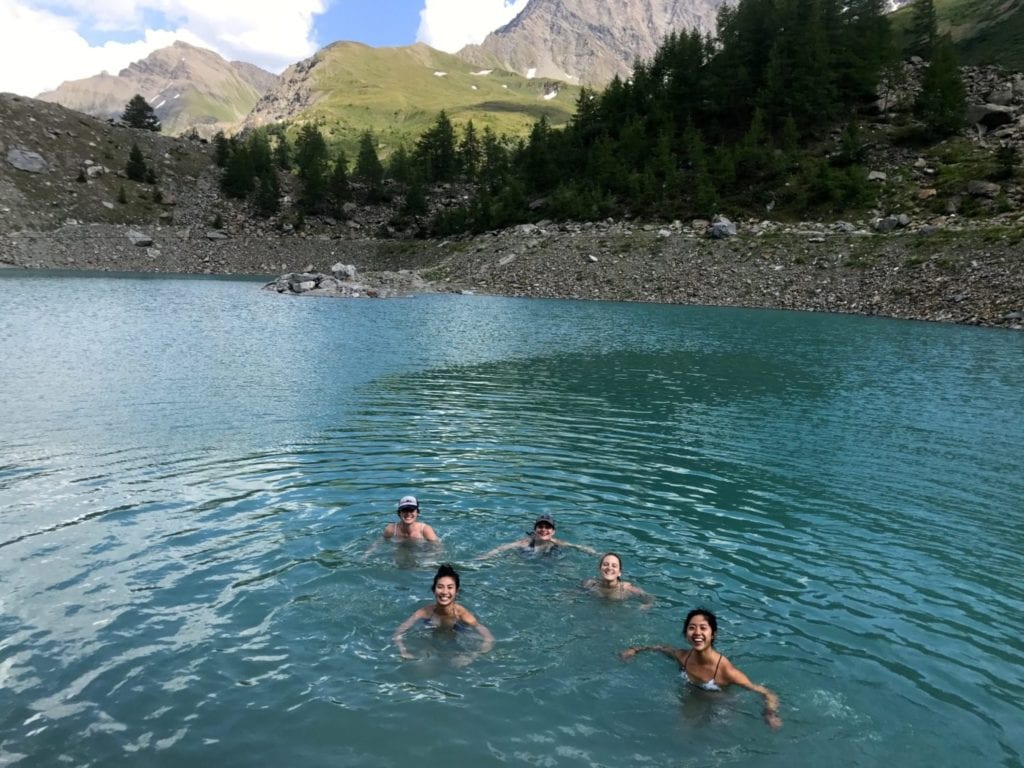
If you plan to swim in alpine lakes or hotel pools, consider bringing 1 swimsuit.
Again, this is only needed if you are going to swim in alpine lakes or pools during your downtime.
20. Sleeping Bag Liner
This item is REQUIRED by the mountain huts. You might not need this for hotels, but some of the beds in the refuges and mountain huts do not come with sheets (gross). For hygienic purposes and germaphobic sanity, get yourself a liner.
If you’re trying to invest in your outdoor gear, I would recommend splurging on the Sea To Summit Reactor Thermolite liner, which you can use for future backpacking/camping trips. For a more affordable option, something like this will do just fine.
21. Casual Loungewear and Pajamas

A good pair of stretchy leggings can double as sleeping and hiking pants. I brought my Lululemon leggings and a random pair of gym shorts, which I hiked in on certain days and slept in for others.
Since I was carrying everything on my back, I wanted to consolidate things by bringing multipurpose clothing items and didn’t bother with lugging around a separate set of pajamas.
22. Flip Flops/Slippers
Bring a pair of waterproof slippers to use in the communal showers and for hanging out in the huts. Some huts won’t allow you to wear your hiking boots around indoors, but they do have communal Crocs that you can borrow.
I personally love my Oofos Recovery Slides, they’re literally meant to reduce the stress on your feet, joints & back.

You’ll also want a lighter pair of cloud-like running shoes (I love HOKA Bondi’s for this) to wear around town when you’re not hiking to give your feet a rest from the hiking boots.
If you can somehow make one pair of shoes count for both purposes, even better.

23. Kindle/Books
You will find that you’ll have a lot of downtime once you finish hiking for the day.
If you enjoy reading, bring a book or a Kindle (they’ve now got glare-free display and weeks of battery life, perfect for this sort of trip).
Read more: Hiking the Tour du Mont Blanc – Itinerary and Description
Tour Du Mont Blanc Packing List: Hydration + Nutrition
24. Electrolytes
On a typical day, most people probably don’t work out hard enough to need to add electrolytes to their water.
The Tour du Mont Blanc is not a typical day.
For 10 straight days, you’ll be climbing thousands of feet uphill, descending steep mountain trails, and sweating far more than you probably realize—even when the temperatures feel cool. You’re not just losing water when you sweat; you’re also losing sodium and other electrolytes that help your muscles function properly and keep you feeling energized.
I recommend packing a box of LMNT electrolyte packets (and sharing with the rest of your group). They’re easy to toss into your backpack, don’t take up much space, and contain significantly more sodium than most electrolyte tablets, making them a better fit for long days of endurance hiking.
If you’re using a hydration reservoir (like a CamelBak), I’d keep your plain water in there and bring a separate water bottle for your LMNT mix. That way, you can alternate between regular water and electrolytes throughout the day without having to flavor your entire reservoir.
25. Water Reservoir

Bring a reservoir with a bite valve and stick it in your backpack for easy access to water while hiking. A 2-liter reservoir will do just fine as there are always places to refill water along the trail.
26. Stinger Waffles
Hiking is one of my favorite excuses to unapologetically load up on quick carbs!!!
When you’re hiking 8-12 miles a day, your body is burning through energy at an incredible rate. This isn’t the time to worry about sugar—it’s the time to keep your legs moving!
Our tour guide understood this well and packed candy bars into our lunch sacks every single day because they were an easy, reliable source of quick calories when we needed a boost on the trail.
We also wanted to bring our own snacks from home as opposed to relying on our tour guide to provide everything to us. My personal favorite hiking snack is Honey Stinger Waffles.
They’re practically a staple among hikers, backpackers, and cyclists for a reason. They’re easy to pack, taste SO SOOOO GOOD, and provide a quick hit of carbohydrates when you start feeling your energy dip. My favorite flavors are cookies and cream, vanilla, and cinnamon, but there are plenty of others to choose from.
27. Stinger Energy Chews
More yummy snacks from the Stinger brand! The Stinger energy chews are like little candy gummies, and they really do give you fast energy when you start to feel drained or sluggish while hiking.
One girl in our group bought 8 packs and shared with the others. Motivation by food, you gotta love it.
Tour Du Mont Blanc Packing List: Toiletries + Miscellaneous Things
28. Laundry Soap
Bring a super-concentrated soap so you can do your own laundry at the huts/hotels. Your clothes will be stinky, and you will definitely want to wash things.
29. Compeed Blister Cushions

You never know when a blister might form on your feet! While I did not personally get any during my hike, my friends did–they were so thankful that I had these with me!
In case of blisters, it’s great to have these assorted blister bandaids on hand.
30. Eye Mask and Ear Plugs
Must, must, must–especially if you’re staying in hostel-style mountain huts!
Many mountain huts are essentially dormitory-style where you share rooms with other hikers. They can get loud with the snoring, so bringing an eye mask set with earplugs is essential.
If you don’t already own an eye mask, the only one I can confidently recommend is the blackout mask by Ostrichpillow; I’ve had mine for years and if anything ever happened to it, I’d replace it in a heartbeat!
31. Sunscreen
Don’t underestimate the alpine sun.
Even on cooler or overcast days, you’ll spend hours hiking at higher elevations with long stretches of exposed trail and very little shade. UV rays are stronger the higher you climb, which makes it surprisingly easy to get burned without realizing it until the end of the day.
I found myself reapplying sunscreen multiple times throughout the hike, especially after sweating through long climbs.
And whatever you do, don’t forget your ears! They were the only part of my body that came close to getting sunburned because I completely overlooked them during one application.
I’d also make sure to cover your neck, the backs of your hands (especially if you’re using trekking poles), and any part of your face not protected by a hat or sunglasses.
A travel-sized sunscreen is all you need—it saves space and is easy to keep in an outer pocket so you actually remember to use it.
32. All Other Toiletries

This one is pretty straightforward: pack your usual toothbrush, toothpaste, deodorant, contacts or glasses supplies, medications, and whatever else is part of your daily routine.
The biggest piece of advice I have is to think travel-size whenever possible. Every ounce adds up when you’re carrying your life on your back for 10 days, so there’s no need to bring full-sized bottles of shampoo, body wash, or lotion.
If you’re staying in hotels or guesthouses, many provide basics like shampoo and body wash, but don’t count on every accommodation having them. Mountain refuges, in particular, tend to be much more bare-bones. I like to pack small travel containers of the essentials so I’m covered no matter where I end up each night.
One last thing that doesn’t always make packing lists: lip balm. Between the dry mountain air, wind, and constant sun exposure, my lips felt much drier than they do on a typical hiking trip, so I was glad I had one handy.
33. Travel Documents
Airline tickets, printed-out confirmations/itineraries, valid passport, extra passport photos.
34. Money
Local currency and bank cards. You’ll need euros for France and Italy, Swiss francs for Switzerland.
A good place to pick up Swiss francs is when you fly into Geneva prior to getting to Chamonix. A good place to pick up Euros is in Chamonix prior to taking off on your trek!
35. Packing Cubes

You need to get these packing cubes, they are amazing at creating space in your luggage that you never thought you had. However you want to organize your clothes— by day, by outfit, by type—these will be the most useful thing you have in your packing artillery.
You’ll no longer need to dig through the entire suitcase for that one thing you’re looking for, because you’ll know exactly where it’s at.
36. Travel Adapter
Necessary if you’re coming from the USA.
This one here is tried and trusted. It got me through my 3.5 months in Europe without any issues at all!
37. Power Bank
Don’t leave for the Tour du Mont Blanc without a portable power bank.
While many hotels and guesthouses have outlets in your room, some mountain refuges have limited electricity. A few shut off the power after dinner, while others only have a handful of outlets in the communal dining room—meaning you’ll be competing with dozens of other hikers trying to charge their phones, cameras, watches, and battery packs before the next day’s hike.
A compact power bank gives you peace of mind that you’ll have enough battery for photos, navigation, emergency communication, and checking tomorrow’s weather forecast.
If you’re shopping for one, I’d actually recommend a wireless magnetic power bank over a traditional one (assuming your phone supports wireless charging). It’s one less charging cable you have to dig out of your backpack every time your phone starts running low.
38. Plastic Bags
For garbage of all sorts. There will not be garbage cans on the trail and you will need to carry your trash until you reach the next refuge or town.
39. Mini First Aid Kit
If you’re going on a guided tour, your guide will likely have this. If you’re doing self-guided, make sure you remember to bring one.
40. Medications
Make sure you bring ibuprofen for the ongoing soreness that’ll develop as you hike, EpiPens/allergy pills for allergies, as well as whatever else is necessary.
41. Sunglasses
It definitely gets sunny on the trails, so having sunglasses is important for eye protection.
While you’re at it, why not accessorize your accessories?
Bringing a pair of sunglasses straps can also be convenient for putting them on/taking them off in a jiffy. And making sure they don’t get lost! The ones by Chums or Croakies are the best if you ask me.

42. Headlamp
Optional, but will be convenient to have if you’re staying at accommodations with shared bathrooms (like refugios).
In some of the mountain huts, the bathrooms are in a separate building from where you’ll be sleeping. If you use the bathroom in the middle of the night, you may need this.
43. Massage Ball
This was the BEST thing in my bag, hands down! Especially after a long day of prolonged hiking.
Roll a massage ball on your legs, upper back, and under your feet whenever you have downtime to undo that tension and soreness you’ve built up over the course of the day. I brought along my TRIGGERPOINT Foam Massage Ball, and it was *chef’s kiss* for my throbbing feet/thighs.
Lessons Learned: Things I Packed (But Didn’t Need)
Everything in this section, in my opinion, is optional!
Insect Repellent
I asked my guide about this, and he noted that because we were that high up, mosquitoes are not really a thing. From personal experience, there weren’t any mosquitoes on the trail.
However, there was one occasion when I was hiking in shorts and felt something ‘bite’ my calf, leaving a few itchy red marks that went away overnight. There are a lot of flying creatures on the trail, but very few of them actually want to suck your blood.
Fancy Thermal/Wool Underwear
If you don’t own these, save your money. Regular undies did just fine for me.

And that about wraps up your Tour du Mont Blanc essentials packing list!
Now that you know precisely what gear to bring for your Tour du Mont Blanc trek, head on over to read my post on how the actual TMB experience went. Happy hiking!
Tour Du Mont Blanc Trekking Guidebooks
 Tour du Mont Blanc: Updated...Shop on Amazon
  Explore Europe on Foot: You...Shop on Amazon
  The Tour of Mont Blanc: Com...Shop on Amazon
Looking for more TMB travel tips? Read More:
Hiking the Tour du Mont Blanc – Itinerary and Description
Hiking the Tour du Mont Blanc – 10-Day Guided Tour Full Breakdown
8 Practical Tips To Help You Conquer The Tour Du Mont Blanc Hike
Other Posts You’ll Love:

10 Europe Travel Mistakes I Made (So You Don’t Have To)
I’ve made enough trips to Europe over the years to know that some travel mistakes…

Visiting London This Winter? 20 Must-Read Travel Tips
Traveling to London in the winter can be an unforgettable experience. From iconic landmarks to…

25 Immersive Things To Do In London For People Who Love Unique Experiences
London is one of the most exciting cities in the world – no matter how…

Off-Beat Paris: 20 Things To Do Other Than Art Museums And Churches
When I travel, I’m all about finding authentic experiences—the kind that doesn’t involve standing in…

Paris, France: 30 Practical Travel Tips For First-Timers
Paris is a city that never fails to enchant, but it can also be overwhelming…

10 Best Women’s Shoes For Walking Around Europe (That Are Actually Cute)
When I went to Europe for the first time in my young 20’s, I decided…

1 thought on “Tour Du Mont Blanc Hike: Your Complete Packing List”